

Every year around budget time, the same thing happens.
- Why the Budget Matters More Than People Realise
- A Quick Note Before We Go Further
- Sector 1: Infrastructure & Construction — Still the Backbone
- Sector 2: Defence — Quietly Becoming Structural
- Sector 3: Manufacturing & PLI — The Real China Plus One Play
- Sector 4: Green Energy & EVs — A Long Game, Not a Trade
- Sector 5: Technology, AI & Digital Infrastructure
- Sector 6: Healthcare & Pharma — Demand You Can’t Ignore
- Sector 7: Agriculture & Rural Economy — The Consumption Engine
- How to Prepare for Budget 2026 (Practically)
- A Free Companion Resource (Highly Recommended)
- Final Thought
Markets move sharply.
News channels start screaming numbers.
WhatsApp groups suddenly become full of “budget stocks”.
And most investors end up doing exactly what they shouldn’t — reacting fast.
But here’s something most people never pause to think about:
The Union Budget is not a trading event.
It’s a signal.
If you read it like an investor — calmly, slowly, and without emotion — it quietly tells you where India’s money, policy, and intent are headed over the next few years.
That’s what this article is about.
No tax slab drama.
No political debate.
No stock tips.
Just how to understand Budget 2026 as an investor, and what kind of thinking actually helps in the long run.
Why the Budget Matters More Than People Realise
Most people look at the budget and ask,
“Market upar jaayega ya neeche?”
That’s the wrong question.
A better question is:
Which parts of the economy are getting long-term support?
The budget impacts investments in three very simple ways:
First, direct spending.
When the government allocates money to infrastructure, railways, defence, or healthcare, that money eventually flows to companies working in those areas.
Second, tax and duty changes.
Even a small customs duty tweak can change profit margins for entire industries.
Third, policy direction.
Schemes like PLI don’t just sound good on paper — they change how companies invest and expand.
If you understand these signals, you stop chasing headlines and start building alignment with reality.
That’s the real edge.
A Quick Note Before We Go Further
Everything discussed here is based on expectations, historical trends, and industry analysis.
Actual numbers will only be confirmed on 1st February 2026.
We’re not a SEBI registered investment advisor.
This is purely educational — meant to help you think better, not tell you what to buy.
Sector 1: Infrastructure & Construction — Still the Backbone
Infrastructure continues to be one of the strongest policy priorities.
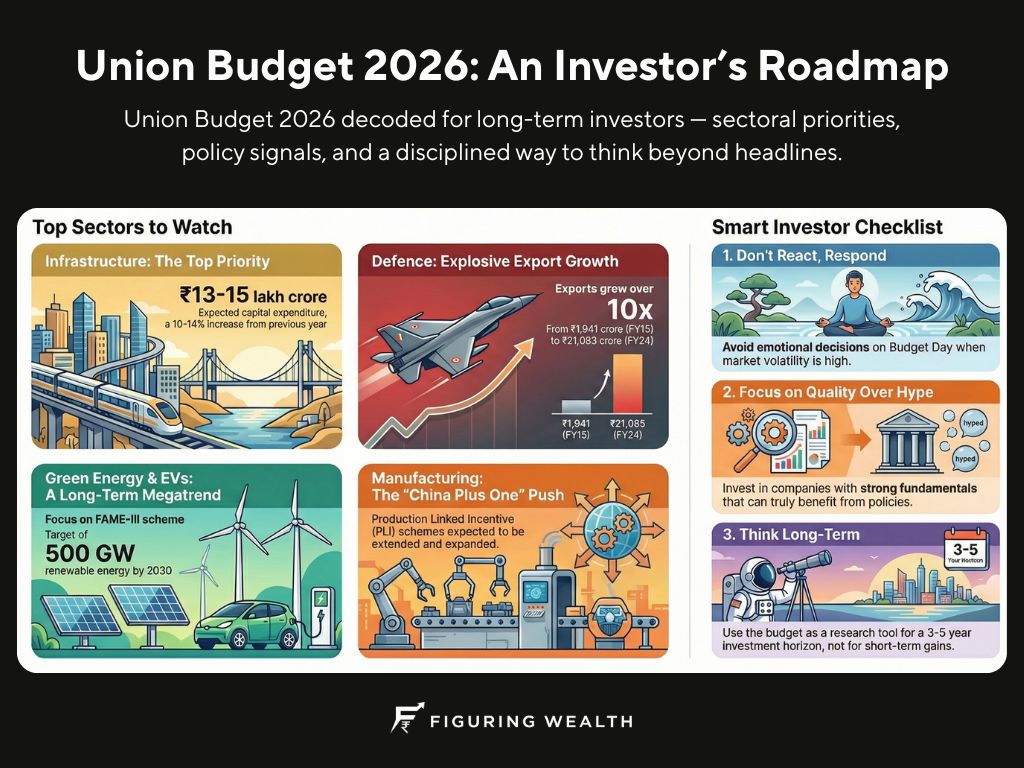
In FY26, government capex stood at ₹11.21 lakh crore.
For Budget 2026, most experts expect a 10–14% increase, which puts the number roughly in the ₹13–15 lakh crore range.
The focus remains familiar:
- Highways and logistics under Gati Shakti
- Railways with a marginal increase
- Urban infrastructure like metros
- Ports and airports for trade efficiency
Why does this matter?
Because infrastructure spending doesn’t work in isolation.
It pulls multiple sectors along with it — construction, steel, cement, banking, logistics.
Between 2020 and 2025, infrastructure allocation nearly doubled. That kind of consistency is rare.
But here’s the part most people miss:
Infrastructure is slow.
Projects take years.
Returns are uneven.
This is not a “budget day trade” theme.
It’s a 3–5 year patience game.

Sector 2: Defence — Quietly Becoming Structural
Defence is no longer just about national security.
It’s becoming an economic theme.
The defence budget has steadily grown:
- FY25: ₹6.21 lakh crore
- FY26: ₹6.81 lakh crore
- Budget 2026 expectation: another 8–10% rise
What’s changed is intent.
India is actively reducing import dependence and pushing domestic manufacturing. Defence exports tell the story clearly — they’ve grown more than ten times over the last decade.
Long-term contracts, government-backed payments, and strategic importance make defence very different from typical cyclical sectors.
That said, volatility is real here.
Defence rewards investors who stay measured — not aggressive.
Sector 3: Manufacturing & PLI — The Real China Plus One Play
PLI is one of the few policy initiatives that has actually delivered results on the ground.
Started in 2021, covering 16 sectors with an outlay of nearly ₹2 lakh crore, it has already changed India’s manufacturing landscape.
Mobile manufacturing alone more than doubled in five years.
Electronics exports jumped sharply.
Employment followed.
For Budget 2026, expectations are:
- PLI extensions
- Deeper focus on advanced manufacturing
- Possible inclusion of AI, robotics, and semiconductors
But here’s an important investor filter:
Not every company in a sector benefits equally.
Only those actually receiving incentives matter.
Headline chasing doesn’t work here. Tracking execution does.
Sector 4: Green Energy & EVs — A Long Game, Not a Trade

Green energy is often misunderstood because people expect fast results.
But this is a 20–30 year transition.
India’s renewable capacity is around 205 GW today.
The target is 500 GW by 2030.
That gap alone explains why this sector keeps getting policy attention.
Budget 2026 expectations include:
- FAME-III for EVs
- More charging infrastructure
- Battery manufacturing support
- Expansion of green hydrogen initiatives
The opportunity is massive — but so is volatility.
Technology changes fast.
Policies evolve.
Winners shift.
The only sensible way to approach this theme is diversification and time.
Sector 5: Technology, AI & Digital Infrastructure
India’s digital public infrastructure is already globally recognised.
What’s happening now is the next phase — AI, data, and computing power.
Budget 2026 expectations revolve around:
- Expansion of the IndiaAI Mission
- Data centre infrastructure support
- Digital skilling programs
- Semiconductor ecosystem development
India’s software exports crossed $200 billion recently.
The long-term target is much higher.
Tech remains one of the few sectors where scalability works in India’s favour.
But global cycles matter here.
So does client concentration.
Balance is key.
Sector 6: Healthcare & Pharma — Demand You Can’t Ignore

Healthcare demand doesn’t depend on sentiment.
It depends on demographics.
India still has only about 0.5 hospital beds per 1,000 people. That gap alone explains why healthcare keeps receiving budget attention.
Budget 2026 expectations include:
- Medical colleges expansion
- Cancer care infrastructure
- PLI extensions for pharma and devices
- Telemedicine support
Healthcare behaves differently from most sectors.
It’s defensive.
It’s steady.
It doesn’t disappear during slowdowns.
But regulation and pricing risks exist, so blind optimism isn’t smart either.
Sector 7: Agriculture & Rural Economy — The Consumption Engine
Nearly 60% of India lives in rural areas.
Rural demand quietly drives:
- FMCG
- Two-wheelers
- Tractors
- Housing materials
Budget 2026 is expected to focus on:
- Productivity improvement
- Crop diversification
- Storage and warehousing
- Credit expansion through KCC
Agriculture is cyclical.
Monsoons matter.
Policies matter.
But when rural income improves, the ripple effect is visible across the economy.
How to Prepare for Budget 2026 (Practically)
This matters more than sector predictions.
Don’t react on budget day.
Markets are emotional that day.
Review your portfolio calmly.
See where you’re overexposed or missing balance.
Keep some cash.
Corrections often come after clarity.
Focus on quality.
Schemes don’t save weak businesses.
Diversify.
Budget expectations can be wrong.
Think long-term.
Budget is a trigger — not the destination.
A Free Companion Resource (Highly Recommended)
We’ve also created a detailed, no-fluff PDF handbook that breaks all of this down visually — sector-by-sector, risks included.
You can download it for free here:
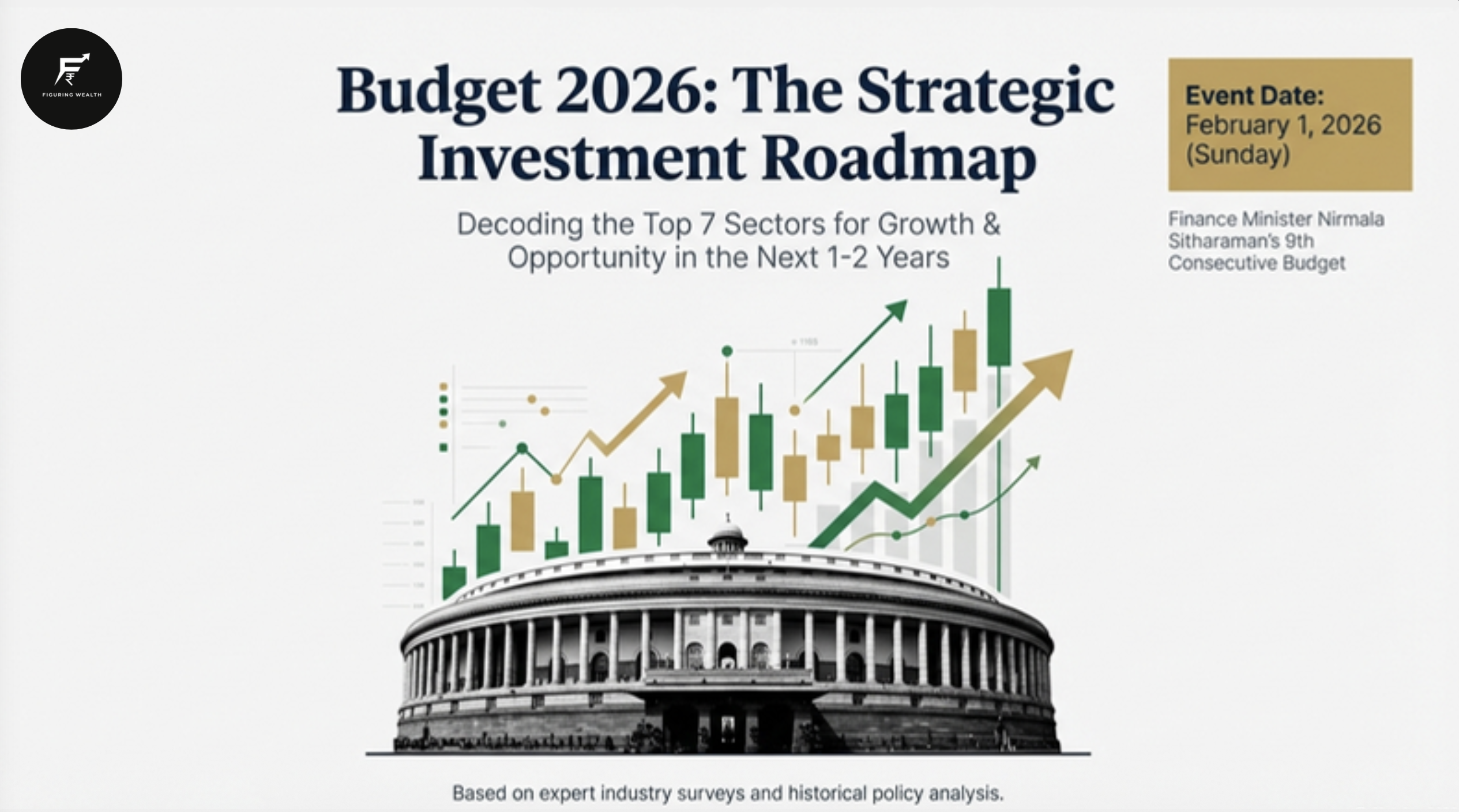
Budget 2026 : The Investment Roadmap by Figuring Wealth
It’s meant to be used alongside this article — not as advice, but as a thinking framework.
Final Thought
Budget 2026 is not about guessing which stock will jump tomorrow.
It’s about understanding where India is placing its long-term bets.
Stocks don’t move because of budgets.
Stocks move because of earnings.
Budgets sometimes help earnings.
The difference between average investors and disciplined ones isn’t access to information.
It’s patience.
It’s filtering noise.
It’s staying aligned with fundamentals.
That’s what Figuring Wealth stands for.
Learn before you earn.